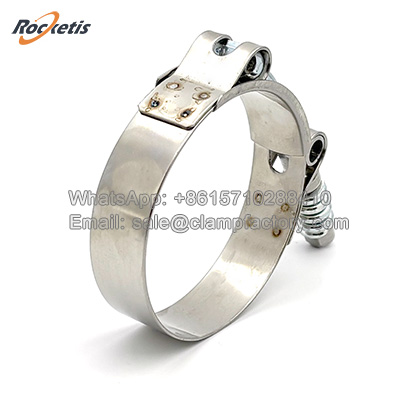
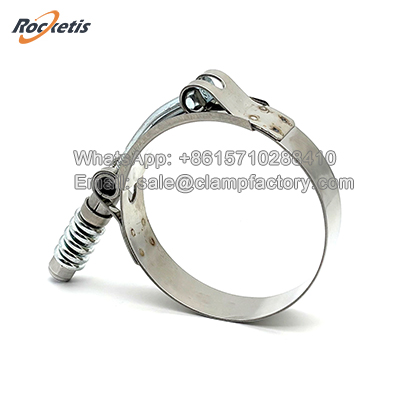
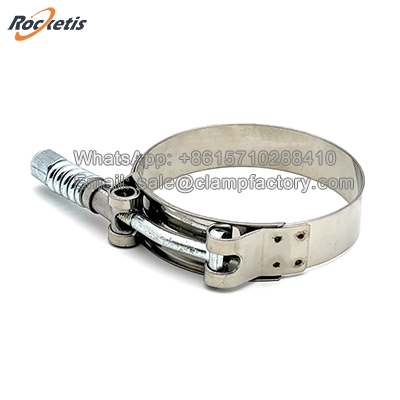
Band width: 19mm (0.75”)
Material: W2 301/W2 304
Free running torque: 6 in-lbs (0.7 Nm)
Suggested installation torque: 77 in-lbs (9 Nm)
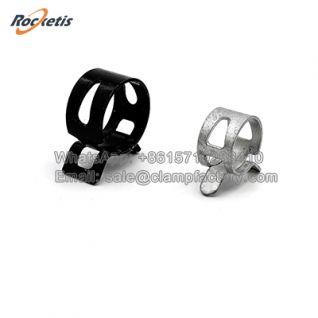
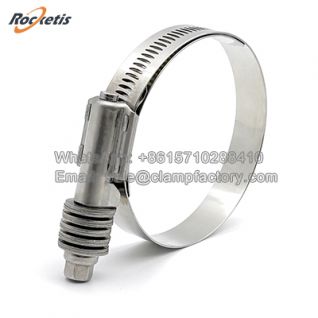
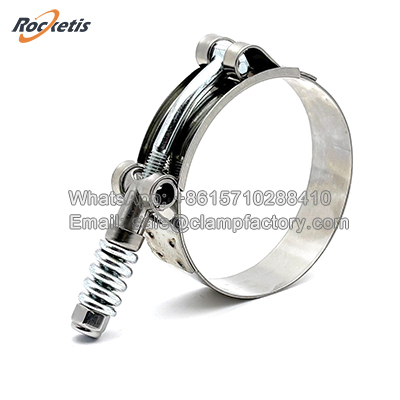
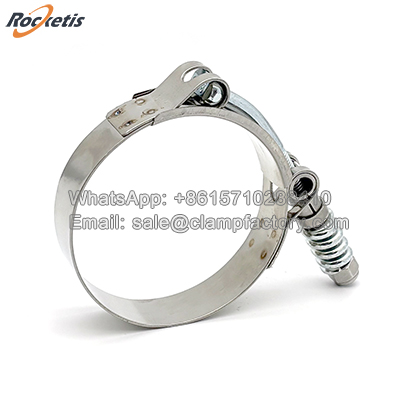
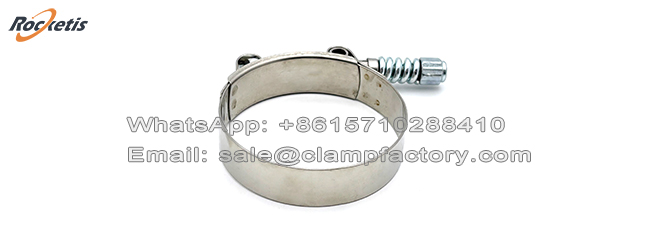
The spring loaded pipe clamps represent evolutionary leap in clamping technology. It transcends the role of a simple fastener, functioning instead as an active, intelligent sealing system. Its core innovation is the integration of a calibrated spring mechanism into the proven T-bolt architecture, creating a clamp that dynamically self-regulates clamping force in response to real-time operating conditions

Spring Loaded Pipe Clamps Operating Dynamics
The Adaptive Spring Assembly: Unlike a passive static clamp, its heart is a precision-stacked column of Belleville disc springs. These are pre-load calibrated—engineered to maintain a precise, predetermined clamping load (e.g., 80 lbs ±5%) regardless of external changes.
Dynamic Reaction Protocol: The clamp operates in two distinct phases:

Initial Seating: The installer tightens the bolt until the spring stack transitions to a solid column, visually confirming correct pre-load is achieved.
Active Service Phase: In operation, as the host assembly breathes—expanding with heat, contracting with cool-down, or subtly settling—the spring column micro-compresses and extends. This live movement continuously takes up slack, neutralizing the forces that would degrade a static seal.
Force Management Philosophy: It addresses the hose system's inherent instability. A hose under pressure can slightly deform; fittings and clamps expand at different rates. This clamp doesn't fight these changes—it accommodates and counters them with equal, opposite spring pressure, maintaining seal interface integrity.

Advantages of spring loaded pipe clamps
Eliminates Progressive Failure: It directly targets and prevents the most common failure path in high-duty systems: the gradual, cyclic loosening leading to leaks or blow-offs, which static clamps cannot inherently stop.
Systems-Level Reliability: By ensuring joint integrity, it protects downstream components from contamination (e.g., oil leaks onto hot turbos) and prevents performance loss from unmetered air ingress in intake systems.
Installation Precision & Error Mitigation: The "collapse point" of the spring serves as an integrated installation sensor, providing clear physical feedback. This dramatically reduces the risk of under- or over-tightening by technicians, ensuring consistent results critical for quality control in manufacturing and assembly.
FAQ of Spring Loaded Pipe Clamps
Q: How does the spring mechanism improve installation speed?
A: The integrated spring provides constant outward tension, allowing the clamp to snap into the strut channel and stay in place without holding it. This enables one-handed installation, which is crucial for high-altitude or overhead piping work.
Q: Are these clamps compatible with all standard 41mm strut channels?
A: Yes, our spring-loaded pipe clamps are designed to fit most standard 41x41 and 41x21 strut channels, providing a secure and universal fit for conduit and pipe support.
Q: Can these be used for vertical pipe runs?
A: Absolutely. The spring tension ensures that the clamp does not slide down the channel during the alignment process, making vertical pipe management significantly easier and more accurate.